Showing posts with label Hugo Awards. Show all posts
Wednesday, June 26, 2019
Hugo Winner Book Review: Dreamsnake by Vonda N. McIntyre
Winner of the Hugo award for besr novel of 1979, this is a touching and beautiful story with an original and imaginative plot, well developed characters, and a fascinating science fiction setting. It is science fiction at its best, where the plot and characters are primary. Earlier dominated by men, by 1979 the Hugo awards were being won about half the time by women, and in recent years women have almost entirely dominated the best novel awards. This is highly recommended ready for anyone, whether science fiction fans or not.
Wednesday, November 21, 2018
Hugo Winner Book Review: The Big Time by Fritz Leiber
This book marks the tenth novel in my quest to read all of the Hugo Award winners.
The Big Time was the winner of best novel for 1958. I found this book a little difficult to read and hard to follow. All the action takes place in one small location over a continuous period of time. Without giving away any spoilers, I thought the concept of the novel was interesting -- and it had a lot of similarities to Asimov's The End of Eternity, which was published three years earlier.
Incidentally, this novel won for 1958 and the last one I reviewed here was for 1956. There was no Hugo winner for best novel in 1957.
I'll get an opportunity to read another novel by the same author when I get to the winner for 1965 and will give him another chance.
Monday, October 22, 2018
Hugo Winner Book Review: The Mule by Isaac Asimov
The 1946 Retro Hugo Award for best novel was awarded to The Mule by Issac Asimov. Awarded in 1996, 50 years after its original publication, the name may not be familiar to Asimov fans as a novel. It is better known for being published as part of the Foundation Series, specifically the second half of the novel Foundation and Empire, the second novel of the Foundation trilogy. Originally it was published as a standalone novella.
The Foundation trilogy (which Asimov later extended into more novels) is perhaps his most famous series of novels, telling an ambitious story of the decline and fall of the galactic empire.
Despite its popularity, some readers find the series heavy in dialog and lacking in action. If you are new to Asimov, I would refer you to first read his short stories and some of his standalone novels before tackling his Foundation series. Then, you will want to start by reading the first novel in the series.
I have read the series several time over the course of many decades of being a science fiction fan. I re-read The Mule as part of my goal of reading all the Hugo award winners. At first I wasn't sure I would re-read it, but before long I was hooked and had to finish it. If found it and easy and enjoyable read.
In 1983, Asimov again won a Hugo when he continued the series with Foundation's Edge, and it was not the last in the series to be written. We'll get to that novel eventually, but not until I read about 30 more Hugo winners first.
Labels:
Asimov,
Foundation Series,
Hugo Awards,
Science Fiction
Wednesday, October 10, 2018
Hugo Award Winner Book Review: Slan, A. E. van Vogt, 1941
Slan, by A. E. van Vogt, was first published in 1940 and won the retro Hugo award for best novel of 1941 (awarded in 2016).
It is a science fiction story, pretty typical of the genre of the time, but with a very original plot. I think it holds up quite well today, other than some scientific explanations of atomic power.
The language used and lack of historical references means that the novel is not too dated and feels quite modern.
The abilities of the protagonist (which could be described as a type of superman) were perhaps a little over the top, reminding me in some ways of the Lensmen in E. E. Smith's Skylark series.
Generally considered to be A. E. van Vogt's best novel, I would highly recommend it as an easy and enjoyable read for science fiction fans.
As a final piece of trivia, A. E. van Vogt was born in Winnipeg, Canada, and was living and working in Ottawa when he wrote this novel. He subsequently moved to Los Angeles when his writing career took off, and remained there for the rest of his life.
Monday, September 3, 2018
Science Fiction Bucket List
The Hugo Awards are a set of literary awards given annually for the best science fiction and fantasy writing. The awards are named after Hugo Gernsback, the founder of the science fiction magazine Amazing Stories. They been awarded annually since 1953.
Prizes are awarded in a number of categories, including best novel.
The Retrospective Hugo Awards, or Retro Hugos, were added in the mid-1990s and are awarded for works published prior to the start of the annual awards.
To date, 70 Hugos have been awarded for best novel, including six retro Hugos.
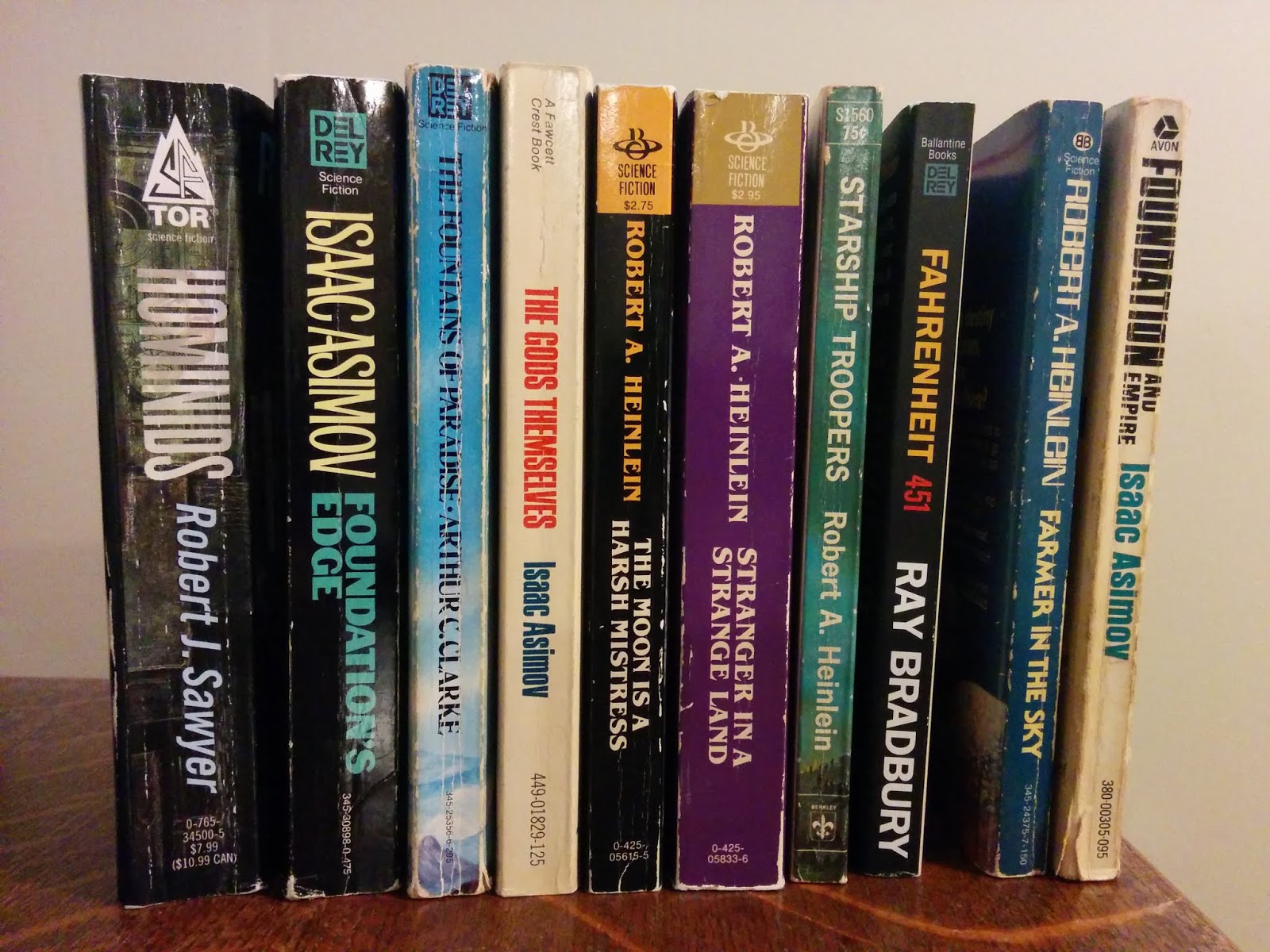
I have read a number of the Hugo award winning novels over the years, and all of my favourite science fiction authors have won at least one award. A check of my science fiction collection identified nine Hugo award winning novels in my bookcase.
I have been wanting to expand my reading of science fiction to include more authors, particularly some more modern novels. The idea occurred to me to set as a goal to read all of the Hugo award winning novels, starting with the first Retro Hugo in 1939, up to the current (2018) winner. I'm going to make an attempt at this, starting with the earliest novels and moving to more recent ones. Ideally, I will reread some novels that I have already read, if it has been some years since I did so.
This may take some time - possibly years - and the list of winning novels will continue to grow as a new one is awarded each year (there will likely be some more retro Hugos awarded as well).
I plan to write a short review of each novel here on this blog.
I now have on order several of the early novels, and a few of them I already own, so I hope to start the first reviews within the next few weeks. I hope some of you will follow my progress, and maybe add your comments if you have read the same novels.
Subscribe to:
Posts (Atom)