Sunday, October 28, 2018

Hugo Winner Book Review: Farmer in the Sky by Robert A. Heinlein


This novel was awarded the retro Hugo for best novel of 1951, awarded in 2001.

This is considered one of Heinlein's juveniles, meaning it was felt suitable for teens and young adults (and adults), at least in 1950.

Many of Heinlein's novels fit this category and most of them, like this one, are extremely good stories for adolescents and adults alike. He never talks down to the reader, but unlike some of his adult novels, they tend to avoid overt preaching of his personal beliefs about government, military, and economics.

To avoid any spoilers, I'll just say that this, like many of his juveniles, could be called a coming of age story, and I thoroughly enjoyed it.

Monday, October 22, 2018

Hugo Winner Book Review: The Mule by Isaac Asimov


The 1946 Retro Hugo Award for best novel was awarded to The Mule by Issac Asimov. Awarded in 1996, 50 years after its original publication, the name may not be familiar to Asimov fans as a novel. It is better known for being published as part of the Foundation Series, specifically the second half of the novel Foundation and Empire, the second novel of the Foundation trilogy. Originally it was published as a standalone novella.

The Foundation trilogy (which Asimov later extended into more novels) is perhaps his most famous series of novels, telling an ambitious story of the decline and fall of the galactic empire.

Despite its popularity, some readers find the series heavy in dialog and lacking in action. If you are new to Asimov, I would refer you to first read his short stories and some of his standalone novels before tackling his Foundation series. Then, you will want to start by reading the first novel in the series.

I have read the series several time over the course of many decades of being a science fiction fan. I re-read The Mule as part of my goal of reading all the Hugo award winners. At first I wasn't sure I would re-read it, but before long I was hooked and had to finish it. If found it and easy and enjoyable read.

In 1983, Asimov again won a Hugo when he continued the series with Foundation's Edge, and it was not the last in the series to be written. We'll get to that novel eventually, but not until I read about 30 more Hugo winners first.

Tuesday, October 16, 2018

Hugo Winner Book Review: Beyond This Horizon by Robert A. Heinlein

(The cover image seems to bear no resemblance to anything in the novel)

Beyond This Horizon, by Robert A. Heinlein, was originally published in Astounding Science Fiction in 1942 and as a novel in 1948. It was awarded a Retro Hugo award for best novel for 1943 in 2018 (on its 75th anniversary).

It is an interesting novel, describing a world about three hundred years in the future.

He predicts a number of things which have come true today, including the water bed, telephones with speech recognition and alarms, use of the metric system, test tube babies, and the technology to analyze DNA.

The novel also promotes many of Heinlein's personal beliefs about society (such as carrying of weapons), marriage, and his then-current interests the Social Credit system of economics, and the General Semantics of Alfred Korzybski.

It even explores the ideas of telepathy and whether there could be some form of existence before and after death.

While I generally consider Heinlein's short stories to be among my favourite science fiction, many of his novels tend to be preachy and transparent vehicles for his personal beliefs. He makes use of some poor plot devices in order to lecture about his ideas.

This was most apparent in his first (unpublished during his lifetime) novel, For Us, The Living: A Comedy of Customs. In Beyond This Horizon is only slightly more subtle.

While the story has many interesting ideas (especially for 1942), I didn't really buy into the plot, or even feel there was one. Later novels, like Stranger in a Strange Land (another Hugo winner, from 1962) showed a lot more maturity. Unfortunately, I found some of his last works, like To Sail Beyond the Sunset, almost unreadable.

Essentially his first novel (though published in book form after Rocket Ship Galileo), I would consider it a good start by a new writer who improved over time, and superior to most novels of the era.

Wednesday, October 10, 2018

Hugo Award Winner Book Review: Slan, A. E. van Vogt, 1941


Slan, by A. E. van Vogt, was first published in 1940 and won the retro Hugo award for best novel of 1941 (awarded in 2016).

It is a science fiction story, pretty typical of the genre of the time, but with a very original plot. I think it holds up quite well today, other than some scientific explanations of atomic power.

The language used and lack of historical references means that the novel is not too dated and feels quite modern.

The abilities of the protagonist (which could be described as a type of superman) were perhaps a little over the top, reminding me in some ways of the Lensmen in E. E. Smith's Skylark series.

Generally considered to be A. E. van Vogt's best novel, I would highly recommend it as an easy and enjoyable read for science fiction fans.

As a final piece of trivia, A. E. van Vogt was born in Winnipeg, Canada, and was living and working in Ottawa when he wrote this novel. He subsequently moved to Los Angeles when his writing career took off, and remained there for the rest of his life.

Thursday, October 4, 2018

Hugo Award Winner Book Review: The Sword in the Stone, T.H White, 1939


[Note: In this and subsequent reviews I will attempt to avoid any major spoilers, but read it at your own risk if you are planning to read any of these books.]

This is the book that was awarded the oldest retro Hugo award to date, and was my starting point for my goal of reading all the Hugo award-winning novels.

Must Hugos are science fiction, but this one is pure fantasy. I'm not a huge fan of the genre (I have enjoyed some though, like the Tolkien books), but I expect as part of my journey I may read some novels that are not to my liking. In fact it was a very enjoyable book and was quite an easy read.

The book tells the story of "Wart", the foster son of Sir Ector, a nobleman who rules a part of England in the middle ages. After their tutor leaves, Wart and Sir Ector's son Kay acquire a new tutor by the name of Merlin (spelled "Merlyn" in the novel). They have many adventures, eventually culminating in the major event that is referenced in the title of the book.

Published in 1939, it combines drama, history, events from the Arthurian legend, and comedy. There are some references to contemporary life (at least of the 1930s). The book eventually became the first of a four part series of novels.

If the name sounds familiar to you, its may be because if formed the basis of a 1963 Walt Disney animated film of the same name. The film follows roughly the same plot as the novel, with some notable differences. Reading the book, it is easy to see how it lent itself to an animated film, due to the use of magic and other elements that would be hard to portray in a live action film (before the days of CGI).

The book contains some very poetic passages, and what to me appear to be quite accurate descriptions of castles and other aspects of life at that time.

I initially wasn't sure it the book was aimed adults or young adults. I would say it appeals equally to both. Many of the terms and words are obscure, but not necessary to follow the plot, and are easy enough to look up today.

I would rate this book as a forgotten classic which is not generally well-known today but should appeal to any reader of, say, the Harry Potter books or the writings of Tolkien who is looking for something new to read.

Very few fantasy novels won the Hugo award, possibly no others until 2001 Harry Potter and the Goblet of Fire.

Monday, September 3, 2018

Science Fiction Bucket List


The Hugo Awards are a set of literary awards given annually for the best science fiction and fantasy writing. The awards are named after Hugo Gernsback, the founder of the science fiction magazine Amazing Stories. They been awarded annually since 1953.

Prizes are awarded in a number of categories, including best novel.

The Retrospective Hugo Awards, or Retro Hugos, were added in the mid-1990s and are awarded for works published prior to the start of the annual awards.

To date, 70 Hugos have been awarded for best novel, including six retro Hugos.

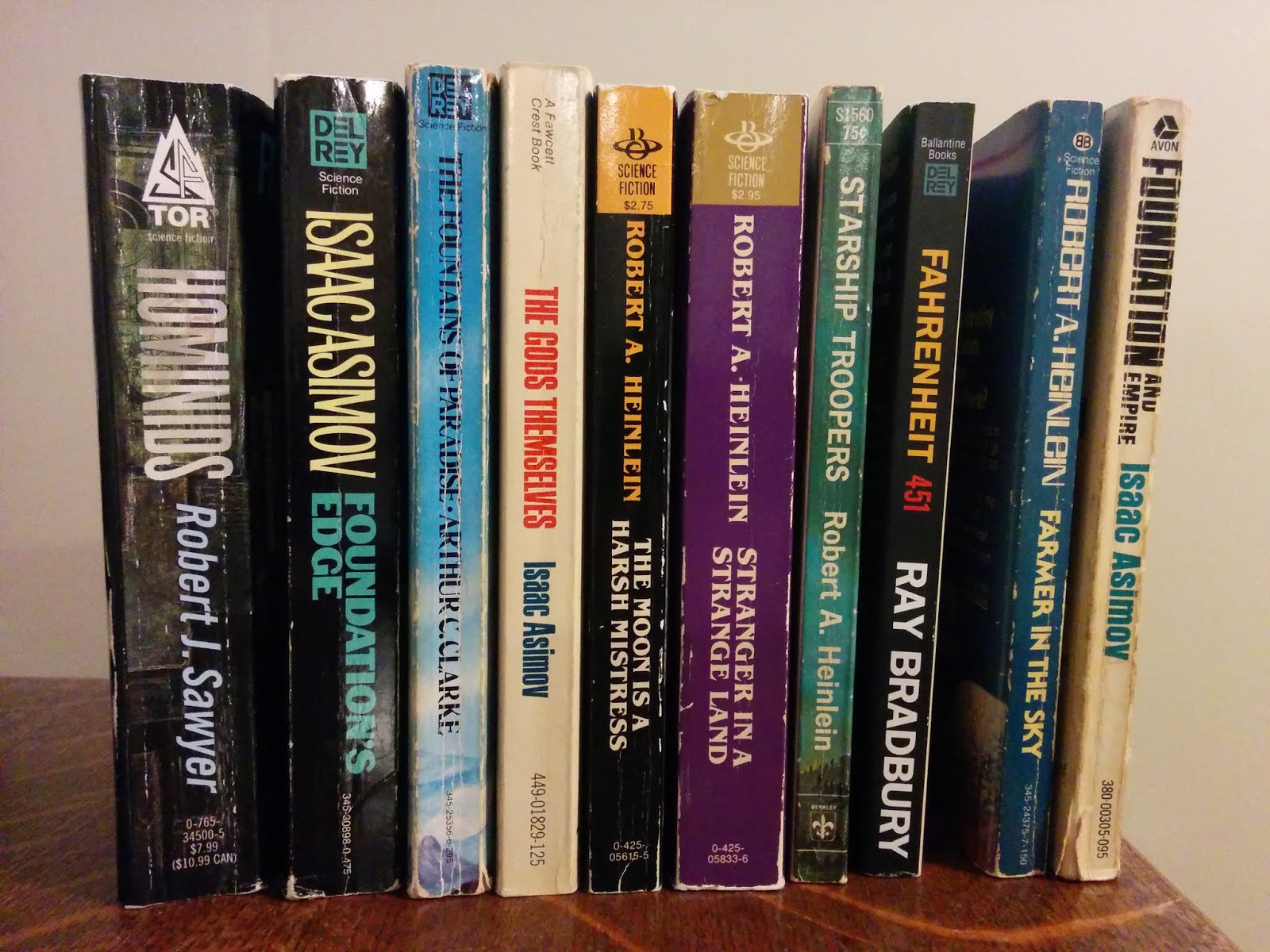
I have read a number of the Hugo award winning novels over the years, and all of my favourite science fiction authors have won at least one award. A check of my science fiction collection identified nine Hugo award winning novels in my bookcase.

I have been wanting to expand my reading of science fiction to include more authors, particularly some more modern novels. The idea occurred to me to set as a goal to read all of the Hugo award winning novels, starting with the first Retro Hugo in 1939, up to the current (2018) winner. I'm going to make an attempt at this, starting with the earliest novels and moving to more recent ones. Ideally, I will reread some novels that I have already read, if it has been some years since I did so.

This may take some time - possibly years - and the list of winning novels will continue to grow as a new one is awarded each year (there will likely be some more retro Hugos awarded as well).

I plan to write a short review of each novel here on this blog.

I now have on order several of the early novels, and a few of them I already own, so I hope to start the first reviews within the next few weeks. I hope some of you will follow my progress, and maybe add your comments if you have read the same novels.

Friday, August 24, 2018

Effective YouTube Videos

I don't consider myself an expert by any means, but after making over 100 YouTube videos I can think of a few tips that will help improve the quality and effectiveness of videos that you might want to make and help you avoid some "newbie mistakes".


You don't need a professional camera, but try to use something better than a smart phone. A digital camera that supports video is one good relatively low-cost option.

Use a tripod! A handheld camera will not cut it. You can buy an inexpensive camera tripod or even improvise something. If you need to shoot while moving, explore low cost camera gimbals.

Use an external microphone. This will greatly improve the sound quality. Also try to record the video in a quiet place (as much as possible) to avoid extraneous sounds like telephones, clocks, pets, people talking, etc.

Edit the video! Make use of some (free) video editing software to edit out mistakes, remove silent portions of the video, and add some basic titles and effects. There can be a bit of a learning curve here, but it can greatly improve how watchable the videos are, and it can be fun.

Use as much light as you can. If you don't have professional lighting, see what you can improvise by adding additional lights over what would normally be in the room.

You may prefer to read from a script, or to make the video impromptu. Either is fine - whatever best fits your personal style. But at least have an overall plan and structure to the video, what you want to say, and what you want to do or show.

Change camera angles often. Try to make use of motion, i.e. don't just show something, but move or operate it.

When uploading to YouTube, give your video a descriptive title, a good description, and add keywords. Fill out other information like language, recording date, etc.

Keep the video short and to the point. You will lose viewers if it goes much beyond 10 or 15 minutes. Edit out silence and don't pad it out with an overly long introduction or background information. Consider splitting a video up into multiple parts if there is a logical way to do so.